
For decades, the downtown office tower represented success.
The bigger the company, the taller the building. Your logo sat in the skyline. Employees commuted into the city. The central business district was where serious companies operated.
But as we move through 2026, it's becoming increasingly fair to ask a question that would have sounded ridiculous twenty years ago:
Is the traditional downtown office tower becoming a dying art?
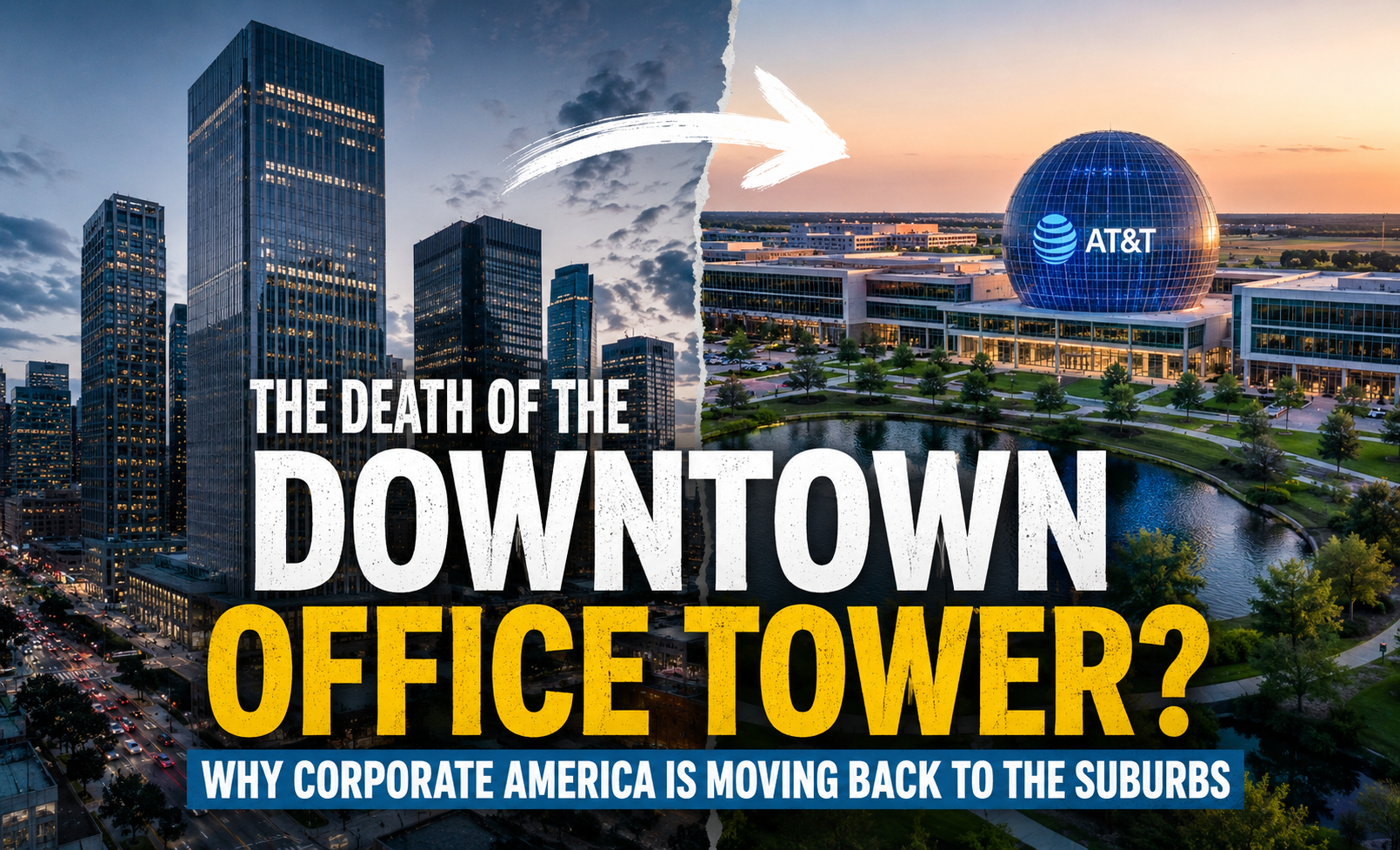
The catalyst that sent me down this rabbit hole was the recent announcement from AT&T. One of the largest companies in America announced plans to relocate its global headquarters from Downtown Dallas to Plano, Texas.
Think about what that actually means.
They're leaving a 37-story office tower in one of the largest downtown environments in the country and moving roughly 22 miles north into mature suburbia. They're trading a vertical environment for a horizontal one. Instead of going long and lean, they're going wide. And they're willing to spend billions of dollars to do it.
At first glance, it's easy to point to the obvious explanations.
A company of that size naturally becomes dispersed over time. Bringing employees together can create operational efficiencies. There are likely economic incentives involved. There are tax considerations. There are real estate considerations.
But I think something bigger is happening underneath all of that.
I think this move reflects a broader shift in how people want to live, work, and spend their time.
The Demographic Reality Nobody Talks About
When people picture large corporations, they often imagine young professionals living in apartments downtown, walking to work, grabbing drinks after hours, and enjoying city life.
And those people absolutely exist.
There are thousands of employees in their early and mid-twenties who are living exactly that lifestyle.
But if we're being honest, they're probably not the majority.
The backbone of most large organizations tends to be people in their thirties and forties. Managers. Directors. Team leaders. Specialists. People with careers, mortgages, spouses, and children.
I spent a long time in corporate finance before moving into real estate, and today I'm 39 years old with two kids under nine.
Most of the people I know are in a very similar stage of life.
Our lives revolve around school schedules.
Sporting events.
School pickups.
School drop-offs.
Art shows at two o'clock on a Thursday.
Random school events at eleven-thirty on a Tuesday.
Birthday parties.
Practices.
Doctor appointments.
Family obligations.
Most households have two working parents.
Most families are juggling multiple children.
Many have dogs.
Most are trying to balance careers while maintaining some sense of sanity.
When you look at life through that lens, the traditional downtown office starts to feel less logical.
Because what happens in practice is that people live in the suburbs anyway.
They choose neighborhoods with better schools.
They choose larger homes.
They choose safer environments.
They choose places where they can raise families.
Then every morning they leave that lifestyle behind and fight traffic to reach an office environment that often exists in complete opposition to how they actually live.
Many of these employees are already commuting 18 to 30 miles every day.
Not enjoyable driving.
Not scenic driving.
Traffic.
Congestion.
Accidents.
Stress.
Mental fatigue.
I did it myself for years.
There were times when a twenty-mile commute took over an hour.
One accident could derail an entire day.
Over time, that burden adds up.
Now imagine a company deciding to move closer to where those employees already live.
Imagine removing a significant portion of that friction.
That's not just a real estate decision.
That's a quality-of-life decision.
Going Where the Talent Already Lives
One of the smartest aspects of this strategy is that companies are increasingly going where their workforce wants to be.
North Texas is a perfect example.
The Dallas-Fort Worth Metroplex continues to produce enormous amounts of residential development. In fact, it remains one of the most active new construction markets in the country.
What makes that important isn't just growth.
It's optionality.
Employees aren't limited to one neighborhood.
They aren't limited to one suburb.
They have choices.
They can move seven miles farther and save substantial money.
They can choose between dozens of neighborhoods.
Different builders.
Different floor plans.
Different school districts.
Different lifestyles.
Different amenities.
The result is an ecosystem where people can live, work, and play within a relatively contained environment.
And increasingly, many people are realizing they don't need to visit downtown nearly as often as they once thought.
The city still serves a purpose.
The best restaurants.
The best hotels.
Major sporting events.
Entertainment.
But those are occasional destinations.
They're no longer daily necessities.
And that distinction matters.
The Rise of the Corporate Campus
The second trend that's impossible to ignore is the growing appeal of the suburban corporate campus.
For years, the office tower represented efficiency.
Stack people vertically.
Maximize density.
Minimize land usage.
But that model has limitations.
If I were designing an ideal work environment today, I would want a few things.
First, I would want it close to where employees actually live.
Second, I would want it connected to walkable mixed-use development.
Not an isolated industrial park.
Not a standalone office building.
I would want coffee shops.
Fitness facilities.
Restaurants.
Retail.
Services.
Places where employees can actually spend time.
Third, I would want proximity to other desirable commercial environments.
Places that create additional value beyond the office itself.
This is where many suburban markets have evolved dramatically.
The old stereotype that suburban life consists of chain restaurants and endless parking lots simply isn't true anymore.
Many suburban environments now offer sophisticated mixed-use districts, high-end retail, entertainment venues, hospitality options, and walkable gathering spaces.
The difference is that they often provide those things in a way that's far more compatible with family life.
Building an Ecosystem Instead of a Building
One of the most overlooked advantages of a suburban mega-campus is that you're no longer just building office space.
You're building an ecosystem.
Think about what a company like AT&T can create.
They can control parking.
They can control circulation.
They can control employee experiences.
They can build hospitality-driven amenities.
They can create internal gathering spaces.
They can create collaborative environments.
They can build wellness facilities.
They can build food options.
They can design intentional spaces that encourage interaction and innovation.
When you're working within a traditional office tower, you're often constrained by the realities of a vertical building.
There's only so much space.
Only so much flexibility.
Only so much customization.
A purpose-built campus allows companies to think much bigger.
It creates opportunities to improve retention.
Improve recruiting.
Improve employee satisfaction.
Improve collaboration.
And perhaps most importantly, it allows companies to create an environment that reflects who they are.
Not just where they rent space.
The New Version of Corporate Prestige
There's also a branding component to all of this.
Historically, prestige came from occupying a tower.
Your logo sat high above the city.
People saw it.
It projected success.
That symbolism still matters.
But I think the definition of prestige is evolving.
AT&T's proposed campus includes plans for a massive illuminated globe that will serve as a landmark feature.
That's not just architecture.
That's branding.
It's a statement.
It's a company planting its flag and saying:
"This is where we are."
"This is our home."
"This is our community."
I've been thinking about this concept a lot lately in my own business.
Ownership creates a different level of control.
When you own the environment, you control the experience.
You control the perception.
You control the message.
And for many organizations, that level of control is becoming increasingly valuable.
The Real Estate Arbitrage Opportunity
The final piece of this puzzle may simply be economics.
Downtown office markets face challenges.
Vacancy rates.
Changing demand.
Aging buildings.
Maintenance costs.
Capital expenditures.
Perception issues.
Safety concerns.
Meanwhile, suburban campuses offer something entirely different.
They're purpose-built.
They're modern.
They're energy efficient.
They're designed around today's needs rather than yesterday's assumptions.
They often come with room for future expansion.
They frequently receive substantial local incentives.
And perhaps most importantly, they provide control.
A company isn't simply leasing space.
They're creating a long-term strategic asset.
Instead of thinking in five-year lease cycles, they're thinking in twenty-five-year horizons.
That's a fundamentally different mindset.
The Future of the Office Isn't Dead—It's Moving
I don't think office space is disappearing.
I don't think corporate headquarters are disappearing.
I don't even think downtown environments are disappearing.
But I do think we're witnessing a shift.
The question is no longer:
"How tall can we build?"
The question is becoming:
"How well can we serve the people who work here?"
For a growing number of companies, the answer appears to be found outside the urban core.
Closer to where employees live.
Closer to where families spend their time.
Closer to the lifestyle people are actually choosing.
And if that trend continues, the suburban corporate campus may become one of the defining commercial real estate stories of the next decade.
The downtown office tower isn't dead.
But for the first time in a very long time, it may no longer be the default answer.
